
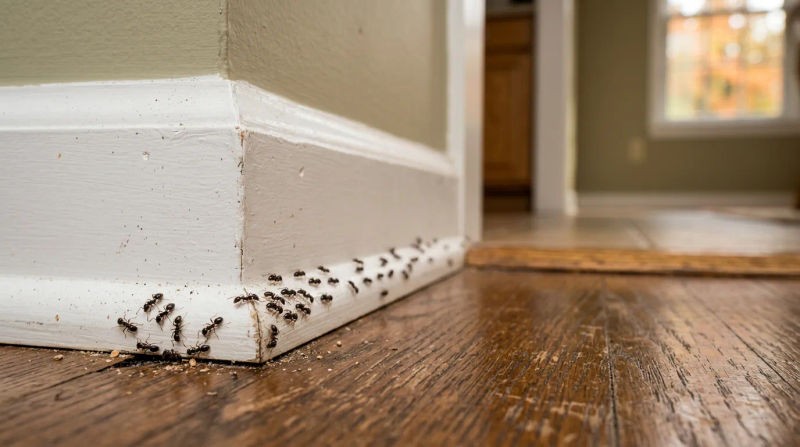
You head into the kitchen for your morning coffee and there it is: a thin, dark line of tiny invaders marching purposefully from beneath the baseboard, across the floor, and toward the dog's food bowl. It’s a sight that can make any homeowner’s stomach drop. As temperatures start to cool down here in Virginia, seeing more ants in house is a common complaint I hear from residents. My name is Derek Whitmore, and for over 12 years, I've been helping folks in the Fredericksburg and Falmouth areas solve their pest problems. This fall shift is predictable; as outdoor food sources dwindle, your warm, food-filled home becomes a five-star resort for ants.
But before you grab a generic spray, it's critical to know what you're dealing with. Not all ants are created equal, and the wrong approach can sometimes make the problem worse. Let's walk through how to identify what's going on.
Common Signs and Symptoms
Finding that ant trail along baseboards Falmouth homeowners frequently report is the most obvious sign, but it's not the only one. The clues these pests leave behind can tell you a lot about the type of ant and the scale of the infestation. When my team and I conduct an inspection, we look for a combination of these signs.
- Visible Ant Trails: These are pheromone highways. Ants lay down chemical trails for their nestmates to follow to a food or water source. The trail's location can point us toward entry points and the resources they’re after.
- Individual Foraging Ants: You might see lone ants wandering around your countertops, sinks, or floors. These are scouts searching for new resources. While one or two might not seem like a big deal, they are messengers for a much larger colony.
- Piles of Frass: This is a crucial sign that points to a specific and destructive pest. Frass looks like fine sawdust or wood shavings. You might find it in little piles on windowsills, along baseboards, or coming from small cracks in walls. This is a tell-tale sign of carpenter ants, who excavate wood to create galleries for their nests.
- Moisture: Ants need water to survive. You'll often find them in kitchens, bathrooms, laundry rooms, and basements. Pay close attention to areas under sinks, around tubs, and near leaky pipes. In many older Falmouth homes, especially those near the river, chronic dampness in a crawl space or basement is a major attractant.
- Strange Noises: In cases of a severe carpenter ant infestation, you might hear faint rustling or crinkling sounds coming from within your walls or ceiling. This is the sound of thousands of ants excavating wood - a truly unsettling experience.
What Causes This Problem
Ants don't end up in your home by accident. Their presence is a symptom of underlying conditions that make your property attractive to them. Understanding these root causes is the first step toward a long-term solution.
The primary driver this time of year is the changing season. As autumn arrives, the aphids and other insects that ants feed on disappear, and plant nectar becomes scarce. Suddenly, the crumbs from last night's dinner or a sticky spot on the counter become an irresistible feast.
Moisture is perhaps the biggest single factor I see in persistent ant infestations. Leaky pipes, poor drainage around the foundation, clogged gutters, and damp crawl spaces create the perfect environment. This is especially true for the carpenter ant vs odorous house ant Virginia debate. While both are drawn to moisture, carpenter ants specifically target water-damaged or damp wood to build their nests. Homes in Falmouth from the 1950s and 1960s, often single-story Ranch-style houses, may have crawl spaces or slab foundations that can trap moisture if not properly ventilated, creating ideal conditions for these pests.
Finally, ants need an entry point. It doesn’t take much. A tiny crack in the foundation, a gap around a window frame, or the space where a utility pipe enters your home is like an open door. Over decades, settling can create numerous small openings in a home's exterior, giving ants easy access.
How to Identify Ants Indoors
Correctly identifying the ant species is the most important step. Treating for the wrong ant is a waste of time and money. Here in our area, two species cause the most confusion and concern: the Odorous House Ant and the Carpenter Ant.
Odorous House Ants:
- Size: Very small, about 1/8-inch long.
- Color: Uniformly dark brown to black.
- Key Feature: The smell! When crushed, they release a distinct odor that many people describe as rotten coconut or a strange, pungent perfume. This is their defining characteristic.
- Behavior: They are nuisance ants. They don't cause structural damage but are relentless in their search for sweets and water. They often form long, distinct trails from their nest to a food source.
Carpenter Ants:
- Size: Much larger, typically 1/4 to 1/2-inch long. They are among the largest ants you'll find inside your home.
- Color: Usually black, but can be a combination of black and reddish-brown.
- Key Feature: Their connection to wood. They don't eat wood, but they chew through it to create smooth, clean galleries for nesting. Finding frass (that sawdust-like material) is a dead giveaway.
- Behavior: They are a wood-destroying insect and a threat to your home's structural integrity. Their presence indicates a moisture problem and potential wood damage.
If you see small, dark ants in a trail leading to a sticky spot on the counter and they smell funny when you squish one, you likely have Odorous House Ants. If you see large black ants and piles of what looks like sawdust near a window frame, you should be concerned about Carpenter Ants.
When to Call a Professional
For a few stray ants, a simple cleanup and sealing a potential entry point might be enough. However, many situations involving ants in house warrant professional help.
Store-bought sprays often only kill the foraging ants you see, not the colony. For certain species, like Odorous House Ants, spraying can cause a phenomenon called